
01AT THE FARM
Sunshine does the work.
A shared solar farm generates electricity and sends it to the local grid. The equipment stays at the farm.
A brighter way to lower your electric bill
The panels live on a shared solar farm. You get credits on your electric bill. Nothing to buy, install, or maintain at home.
For renters & homeowners. Availability depends on your utility.
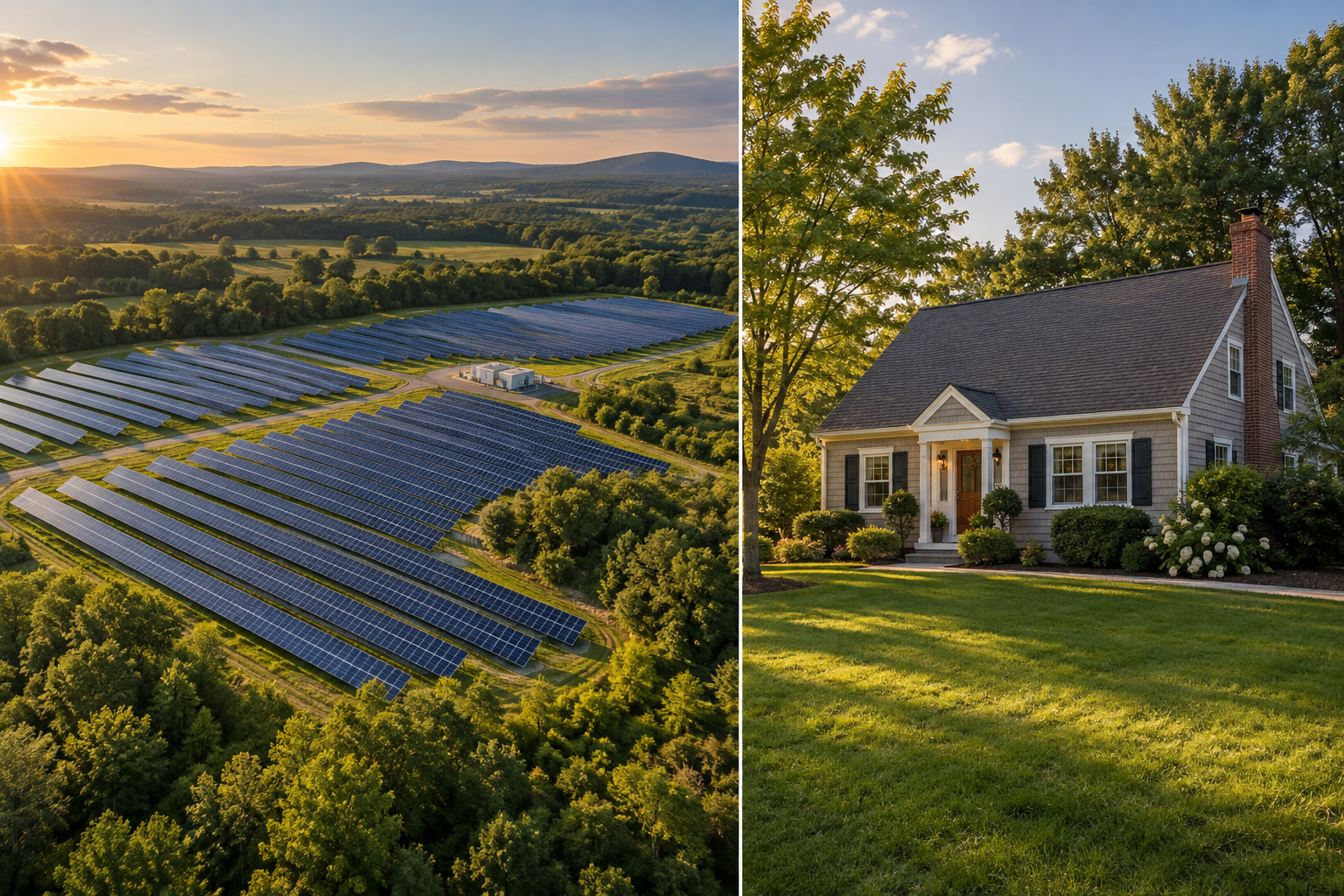 The panels go here.Your home stays yours.
A solar farm somewhere else.
A little more in your pocket.
Two different places. One simple idea. Illustrative imagery.
Let's clear up the big misconception
Community solar lets you subscribe to a share of a solar farm's output. It connects to the power grid, not to your house.
A shared solar farm generates electricity and sends it to the local grid. The equipment stays at the farm.
Your subscription earns solar credits on your electric bill. Your utility still delivers your electricity.
You receive credits at a discount under your program's terms. That difference is your savings.
No installer. No roof inspection. No equipment loan. Just a different way to benefit from solar.
The part your wallet will appreciate
You don't buy panels. In a discounted-credit program, you pay less for solar credits than they're worth on your utility bill.
Some programs combine everything on one bill; others send a separate subscription bill. Your offer explains exactly how you'll be billed.
See what I qualify forIllustration of a 10% discount on solar credits, not a promise of 10% off your entire bill. Actual savings and credit amounts depend on your program.
Less jargon. More “oh, I get it.”
A quick introduction to a different kind of solar, plus a community solar news report from our video library.
 START HERE
Our original community solar explainer
 FROM OUR VIDEO LIBRARY
Channel 4 report featuring the Pepco area
These are videos from our original site. Offers and program details may have changed; use the availability check for current options.
Your roof is not the requirement
Community solar is for people who want the benefits of solar without a home improvement project.
Eligibility depends on your state, utility, project capacity, and program requirements—not whether your roof is right for solar.
Good questions. Straight answers.
Understand what changes—and what stays exactly the same.
Really. No panels go on your roof, in your yard, or anywhere on your property. The panels are at a shared solar project elsewhere. You subscribe to a share of its output.
No. Your utility continues to deliver electricity and maintain the grid. Community solar adds bill credits tied to your subscription; it isn't a rooftop installation or a switch of utility company. The finder checks which programs work with your utility.
You aren't buying or financing solar equipment for your home. In a discounted-credit program, you pay for credits at less than their value on your utility bill. For example, $100 in credits at a 10% discount costs $90, leaving $10 in savings. Billing, fees, and discounts depend on the specific offer—review them before enrolling.
Your savings depend on your utility, the available project, and any household eligibility requirements. Some programs offer enhanced savings to qualifying households. Check availability to see your actual options; we don't promise one savings rate for everyone.
Yes, renters may be eligible when they have a qualifying electric account in a participating utility area. Because nothing is installed on the property, a suitable roof or ownership of your home isn't required.
You may be able to transfer a subscription within the same utility territory. If you're moving outside it, or want to leave, follow your subscription's cancellation process. Notice periods and fees vary by program; check those terms before signing up.
The JoinCommunity.Solar finder currently lists Maryland, Delaware, Washington, D.C., New Jersey, New York, and Maine. Not every utility or household qualifies, and projects can fill up. Use the finder to check the current options for your state and utility.
Check my availability ↗The farm sends electricity to the shared power grid. Your home continues to receive electricity through your utility as usual. Your subscription is connected to the farm's output through bill credits, not through a dedicated wire to your house.
Your roof can sit this one out.
Find out whether community solar can lower your electric costs.
Find my solar savingsNo installation. No equipment purchase. Your utility stays your utility.